Trading Academy
 Forex Glossary
 Trading Guides
 News
News Blog
Blog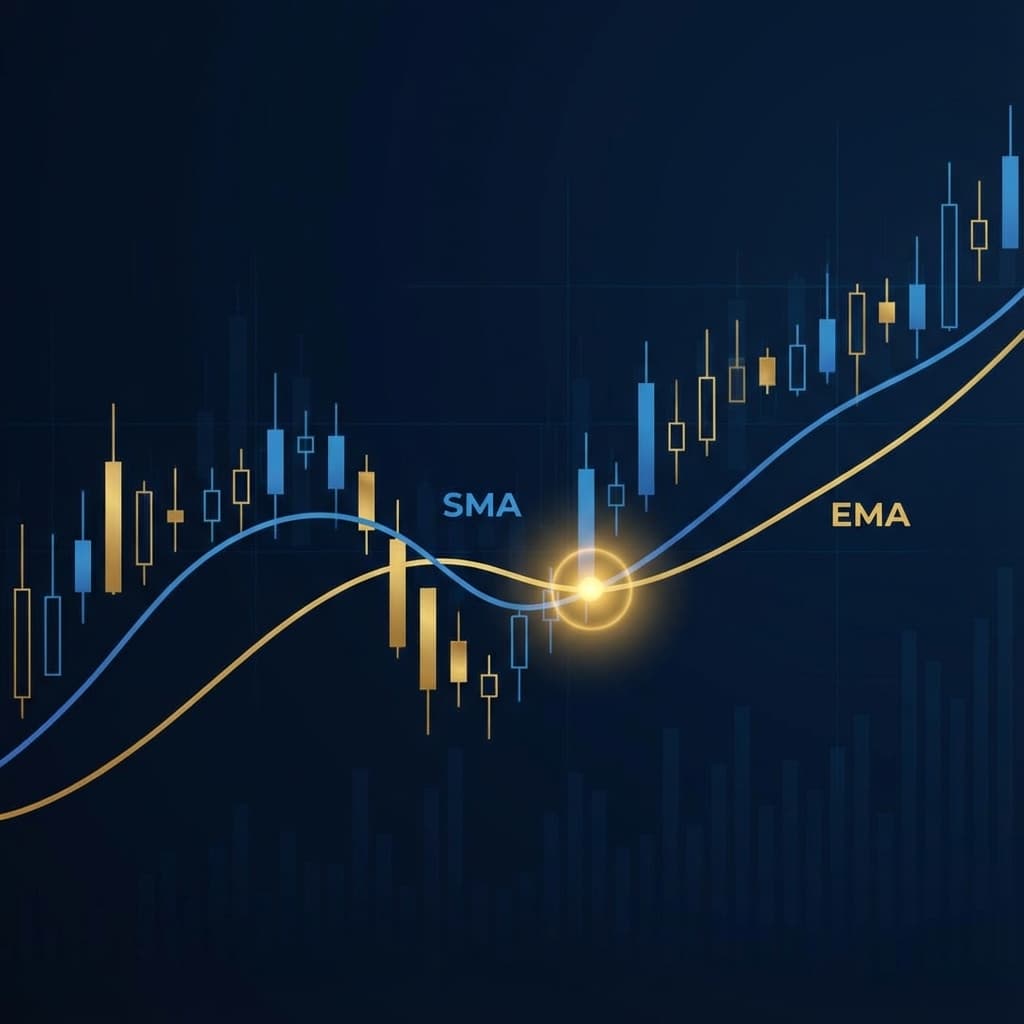





Key Takeaways
- Moving Averages (MA) smooth out price data to identify the trend direction clearly.
- Simple Moving Average (SMA): Calculates the average of past X prices. Smoother but slower to react.
- Exponential Moving Average (EMA): Gives more weight to recent prices. Faster reaction time.
- Golden Cross: A bullish signal when the 50 MA crosses above the 200 MA.
- Death Cross: A bearish signal when the 50 MA crosses below the 200 MA.
- MAs act as dynamic support and resistance levels in trending markets.
Table of Contents
What Are Moving Averages?
The Moving Average is arguably the most widely used indicator in all of trading. It's the grandfather of technical analysis—simple, effective, and used by everyone from retail traders to the largest hedge funds and institutions.
A moving average "smooths out" price data by creating a constantly updated average price over a specific time period. Instead of looking at the chaotic up-and-down movements of individual candles, the MA shows you the underlying trend direction.
Think of it like looking at a landscape from an airplane versus walking through it. The airplane view (moving average) shows you the overall terrain and direction, while walking (individual candles) shows every bump and rock. Both perspectives are valuable, but traders use MAs to filter out noise and see the bigger picture.
SMA vs EMA: The Key Difference
There are two main types of moving averages, and understanding their differences is crucial:
Simple Moving Average (SMA)
The SMA is the simplest form. It calculates the average of the last X closing prices, giving equal weight to each price.
Formula: SMA = (P1 + P2 + P3 + ... + Pn) ÷ n
Example: 10-period SMA adds the last 10 closing prices and divides by 10.
Pros: Smoother line, fewer false signals. Cons: Slower to react to price changes. Better for identifying long-term trends.
Exponential Moving Average (EMA)
The EMA gives more weight to recent prices, making it more responsive to current price action. This means it "turns" faster than the SMA.
Pros: Faster reaction to price changes, better for short-term trading. Cons: More susceptible to whipsaws (false signals). Better for entries and active trading.
| Feature | SMA | EMA |
|---|---|---|
| Calculation | Equal weight to all prices | More weight to recent prices |
| Reaction Speed | Slower | Faster |
| Best For | Long-term trends | Short-term trading |
| False Signals | Fewer | More |
Most Popular MA Periods
Moving averages work because traders worldwide watch the same key periods. When millions of traders react to the same levels, they become self-fulfilling. These are the most commonly used periods:
- 10/20 Period: Short-term trend. Popular for scalping and day trading entries.
- 50 Period: Intermediate trend. The "medium-term" trend indicator.
- 100 Period: Often used as a longer-term trend filter.
- 200 Period: The "big picture" trend. The most respected and watched MA globally.
The 200 EMA/SMA on the daily chart is particularly significant. Many institutional traders use it to define whether the market is bullish (price above 200 MA) or bearish (price below 200 MA).
Using MAs to Identify Trends
The simplest and most powerful use of moving averages is identifying the trend. Follow these rules:
Bullish Trend
- Price is above the 200 EMA
- The MA slope is pointing upward
- Look for buy opportunities
- Pullbacks to the MA are buying opportunities
Bearish Trend
- Price is below the 200 EMA
- The MA slope is pointing downward
- Look for sell opportunities
- Rallies to the MA are selling opportunities
Pro Tip: Use multiple MAs together. For example, if price is above the 20, 50, AND 200 EMA, and they're stacked in order (20 on top, then 50, then 200), you have a strong uptrend.
Trading MA Crossovers
When a faster moving average crosses a slower moving average, it signals a potential change in momentum. These crossovers are used by traders worldwide.
The Golden Cross
A Golden Cross occurs when the 50 MA crosses ABOVE the 200 MA. This is a major bullish signal suggesting a long-term uptrend may be starting.
- Often used as a buy signal for position traders and investors
- Works best when confirmed by increasing volume
- On daily charts, can signal trends lasting months or years
The Death Cross
A Death Cross occurs when the 50 MA crosses BELOW the 200 MA. This is a major bearish signal suggesting a long-term downtrend may be starting.
- Often used as a sell/short signal or an exit trigger for longs
- Can protect portfolios from major market declines
- Also works on lower timeframes for shorter-term trades
Shorter-Term Crossovers
For more active trading, use faster combinations like 10/20 EMA or 20/50 EMA crossovers. These generate more signals but also more false ones. Combine with other indicators like RSI or MACD for confirmation.
Dynamic Support and Resistance
In trending markets, moving averages act as dynamic support and resistance. Unlike horizontal S/R levels that are static, MAs move with time, creating a "moving" floor or ceiling for price.
How to Trade MA Bounces
- In an Uptrend: Watch for price to pull back DOWN to the 20 or 50 EMA. If it bounces, that's a buy signal.
- In a Downtrend: Watch for price to rally UP to the 20 or 50 EMA. If it rejects, that's a sell signal.
- Confluence: MA bounces are stronger when they align with horizontal support/resistance or Fibonacci levels.
Strong trends often "ride" along the 20 EMA, with each pullback presenting an entry opportunity. When price starts closing below the 20 EMA consistently, the trend may be weakening.
Moving Average Trading Strategies
Strategy 1: Trend Filter + Entry
Use the 200 EMA to define the trend, then use the 20 EMA for entries:
- Only look for LONG trades when price is above the 200 EMA
- Wait for price to pull back to the 20 EMA
- Enter when price bounces off the 20 EMA with a bullish candle
- Stop-loss below the recent swing low
Strategy 2: Triple MA System
Use three MAs (e.g., 10, 20, 50 EMA) for clear trend identification and entries:
- Bullish: 10 EMA > 20 EMA > 50 EMA (all stacked and sloping up)
- Enter when price retests the 10 or 20 EMA and bounces
- Exit when 10 EMA crosses below 20 EMA (momentum fading)
Strategy 3: MA Envelope or Bands
Some traders add bands around a moving average (like Bollinger Bands or Moving Average Envelopes) to identify overbought/oversold conditions within a trend. When price touches the upper band in an uptrend, it may be extended; the lower band may offer buying opportunities.
Limitations of Moving Averages
No indicator is perfect. Understanding MA limitations helps you avoid common pitfalls:
- Lagging Indicator: MAs are based on past prices. By definition, they will always be "late" to a trend change. They confirm trends rather than predict them.
- Whipsaws in Ranging Markets: MAs work best in trending markets. In sideways, choppy conditions, they generate many false signals as price crosses back and forth.
- No Price Target: MAs tell you direction but not how far price will go. Use other tools for targets.
- Period Selection: Different periods work better in different market conditions. There's no "magic" setting.
Solution: Combine MAs with oscillators like RSI to identify ranging vs. trending conditions. Don't trade crossovers when MAs are flat and tangled together.
Frequently Asked Questions
Which MA period is best for forex trading?
The most respected periods are 20, 50, 100, and 200. For day trading, 9 and 21 EMAs are popular. For swing trading, 50 and 200 are commonly used. There's no single "best" period—it depends on your trading style.
Should I use SMA or EMA?
For faster, short-term signals, use EMA. For smoother, long-term trend identification, use SMA. Many traders use EMA for shorter periods (20) and SMA for longer periods (200). Experiment on a demo account to see what works for you.
Why do moving averages fail in ranging markets?
Moving averages are trend-following indicators. In a sideways market, price constantly crosses the MA, generating false buy and sell signals (whipsaws). Use the ADX indicator to determine if the market is trending before relying on MA signals.
Can I use moving averages on any timeframe?
Yes, MAs work on all timeframes. However, signals on higher timeframes (Daily, Weekly) are generally more reliable than on lower timeframes (M1, M5). The 200 MA on a 1-minute chart has little significance compared to the 200 MA on a daily chart.
What does it mean when price is far from the MA?
When price is significantly extended from its moving average, it's often "overextended" and may snap back (mean reversion). This is the basis of strategies like trading back to the mean. However, in strong trends, price can stay extended for a long time.
How many moving averages should I use on my chart?
Less is more. Using too many MAs clutters your chart and creates analysis paralysis. Most traders use 2-3 MAs maximum. A common setup is one short-term (20), one medium-term (50), and one long-term (200).
For deeper comparison, review our best forex brokers, check individual broker reviews, use the Match Me to a Broker quiz, and calculate risk with the position size calculator.