Trading Academy
 Forex Glossary
 Trading Guides
 News
News Blog
Blog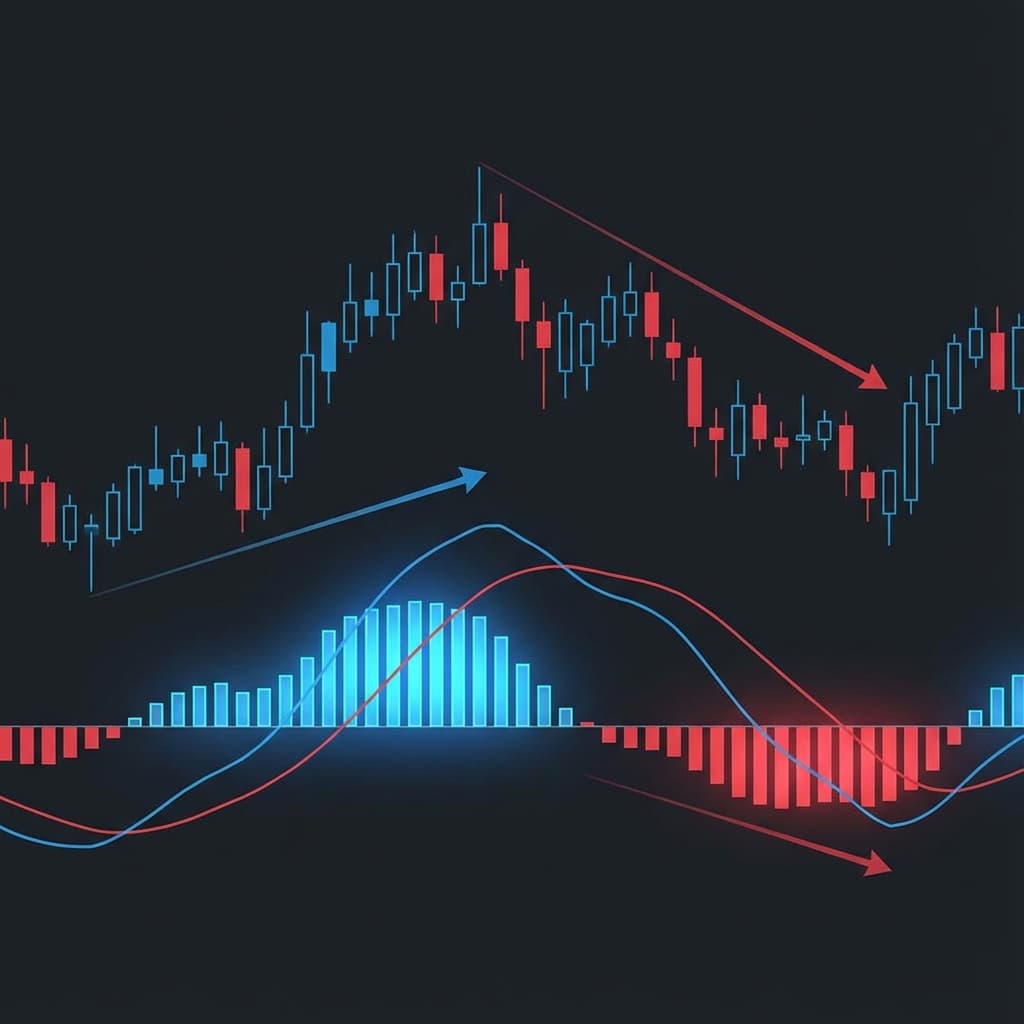





Key Takeaways
- MACD (Moving Average Convergence Divergence) reveals trend direction, momentum strength, and potential reversals.
- Signal Line Crossovers: When MACD crosses above the signal line = bullish; below = bearish.
- Histogram: Shows the difference between MACD and signal line—growing bars = strengthening momentum.
- Zero Line Crossovers: MACD crossing above zero confirms bullish trend; below confirms bearish.
- MACD Divergence: When price and MACD disagree, reversals often follow.
- Developed by Gerald Appel in the 1970s, MACD remains one of the most trusted indicators.
Table of Contents
What is MACD?
The Moving Average Convergence Divergence (MACD) is a trend-following momentum indicator that shows the relationship between two moving averages of a security's price. Developed by Gerald Appel in the late 1970s, MACD has become one of the most popular and trusted tools in technical analysis.
What makes MACD special is its versatility—it functions as both a trend indicator (showing direction) and a momentum oscillator (showing strength). This dual nature allows traders to identify not just when trends are present, but when they might be starting, ending, or accelerating.
In this guide, we'll break down every component of MACD and teach you multiple trading strategies based on this powerful indicator.
Understanding the Three Components
MACD consists of three visual elements, each providing unique trading information:
1. MACD Line (Fast Line)
Calculation: 12-period EMA minus 26-period EMA
This is the core of the indicator. When short-term momentum (12 EMA) is above long-term momentum (26 EMA), the MACD line is positive. When it's below, the line is negative. The further apart these EMAs get, the more extreme the MACD reading.
2. Signal Line (Slow Line)
Calculation: 9-period EMA of the MACD Line
The signal line smooths out the MACD line. Crossovers between MACD and its signal line generate buy/sell signals. Think of it as a "trigger" line—when MACD crosses it, it's time to act.
3. Histogram
Calculation: MACD Line minus Signal Line
The histogram visualizes the gap between MACD and its signal line. When MACD is above the signal, the histogram is positive (green bars). When below, it's negative (red bars). The size of the bars shows how far apart the lines are—bigger bars = stronger momentum.
Signal Line Crossover Strategy
The most common MACD trading strategy uses signal line crossovers:
Bullish Signal
- MACD line crosses above the signal line
- Histogram turns from negative to positive
- Interpretation: Momentum is shifting bullish
- Action: Look for long entry opportunities
Bearish Signal
- MACD line crosses below the signal line
- Histogram turns from positive to negative
- Interpretation: Momentum is shifting bearish
- Action: Look for short entry opportunities
Pro Tip: Signal line crossovers work best when they occur away from the zero line. Crossovers near zero (during choppy, trendless markets) often produce false signals.
Zero Line Crossover Strategy
The zero line acts as a trend filter and confirmation tool:
- MACD above zero: The 12 EMA is above the 26 EMA—bullish momentum dominates. Only look for buy setups.
- MACD below zero: The 12 EMA is below the 26 EMA—bearish momentum dominates. Only look for sell setups.
- Crossing above zero: Confirmation of new uptrend beginning.
- Crossing below zero: Confirmation of new downtrend beginning.
Many traders use zero line position as a filter: only take bullish signal crossovers when MACD is above zero, and only bearish crossovers when MACD is below zero. This keeps you trading with the trend.
Reading the Histogram
The histogram provides early warning signals before crossovers occur:
| Histogram Pattern | Meaning | Implication |
|---|---|---|
| Growing Green Bars | MACD pulling away from signal line (upward) | Bullish momentum accelerating |
| Shrinking Green Bars | MACD converging toward signal line | Bullish momentum weakening—prepare for crossover |
| Growing Red Bars | MACD pulling away from signal line (downward) | Bearish momentum accelerating |
| Shrinking Red Bars | MACD converging toward signal line | Bearish momentum weakening—prepare for crossover |
Key Insight: Shrinking histogram bars often precede crossovers, giving you advance notice to prepare. Some traders enter positions based on histogram shrinkage before the actual crossover.
MACD Divergence Trading
Like RSI, MACD divergence is a powerful reversal signal. It occurs when price and MACD move in opposite directions:
Bullish Divergence
- Price makes a lower low
- MACD makes a higher low
- Signal: Selling pressure is weakening despite falling prices
- Implication: Potential reversal to the upside
Bearish Divergence
- Price makes a higher high
- MACD makes a lower high
- Signal: Buying pressure is weakening despite rising prices
- Implication: Potential reversal to the downside
When MACD divergence is confirmed by candlestick reversal patterns, the probability of a successful trade increases significantly.
Default vs Custom Settings
The standard MACD settings are 12, 26, 9 (fast EMA, slow EMA, signal line). You can adjust these for different trading styles:
| Style | Settings | Characteristics |
|---|---|---|
| Fast (Scalping) | 5, 13, 5 | More signals, more noise, faster response |
| Standard | 12, 26, 9 | Balanced, most tested |
| Slow (Swing) | 19, 39, 9 | Fewer signals, less noise, big moves only |
Combining MACD with Other Indicators
MACD is most effective when combined with complementary tools:
- RSI: Use MACD for direction, RSI for overbought/oversold timing. When both show divergence, signals are very strong.
- Moving Averages: Use a 200 MA for trend direction, MACD for entries. Only take MACD buy signals when price is above 200 MA.
- Support/Resistance: MACD bullish crossover at major support = high-probability trade.
- Bollinger Bands: MACD crossover combined with price at Bollinger Band outer extremes creates confluence.
For multi-indicator setups, consider MT4 brokers or MT5 platforms that allow extensive customization.
Frequently Asked Questions
Is MACD a leading or lagging indicator?
MACD is primarily a lagging indicator since it's based on moving averages. However, the histogram and divergence signals can provide leading indications of potential changes in trend.
Why do MACD crossovers sometimes fail?
In choppy, range-bound markets, MACD produces many false signals because there's no clear trend to follow. The solution is to use a trend filter (like the 200 MA or zero line position) to avoid trading during consolidation.
What's better: MACD or RSI?
They measure different things! MACD shows trend and momentum, while RSI shows overbought/oversold conditions. Most professional traders use both together rather than choosing one.
Should I use MACD on lower timeframes?
MACD works on any timeframe, but signals are more reliable on higher timeframes (4H, Daily). If using on lower timeframes, consider adjusting to faster settings (like 5, 13, 5) for scalping strategies.
How do I avoid MACD whipsaws?
Wait for the candle to close before acting on crossovers, use additional confirmation from price action or other indicators, and only trade crossovers that occur in the direction of the higher timeframe trend.
What does it mean when MACD lines are far from zero?
When MACD is far above zero, the market is strongly bullish and potentially overextended. When far below zero, it's strongly bearish and potentially oversold. Extreme readings often precede pullbacks or reversals.