Trading Academy
 Forex Glossary
 Trading Guides
 News
News Blog
Blog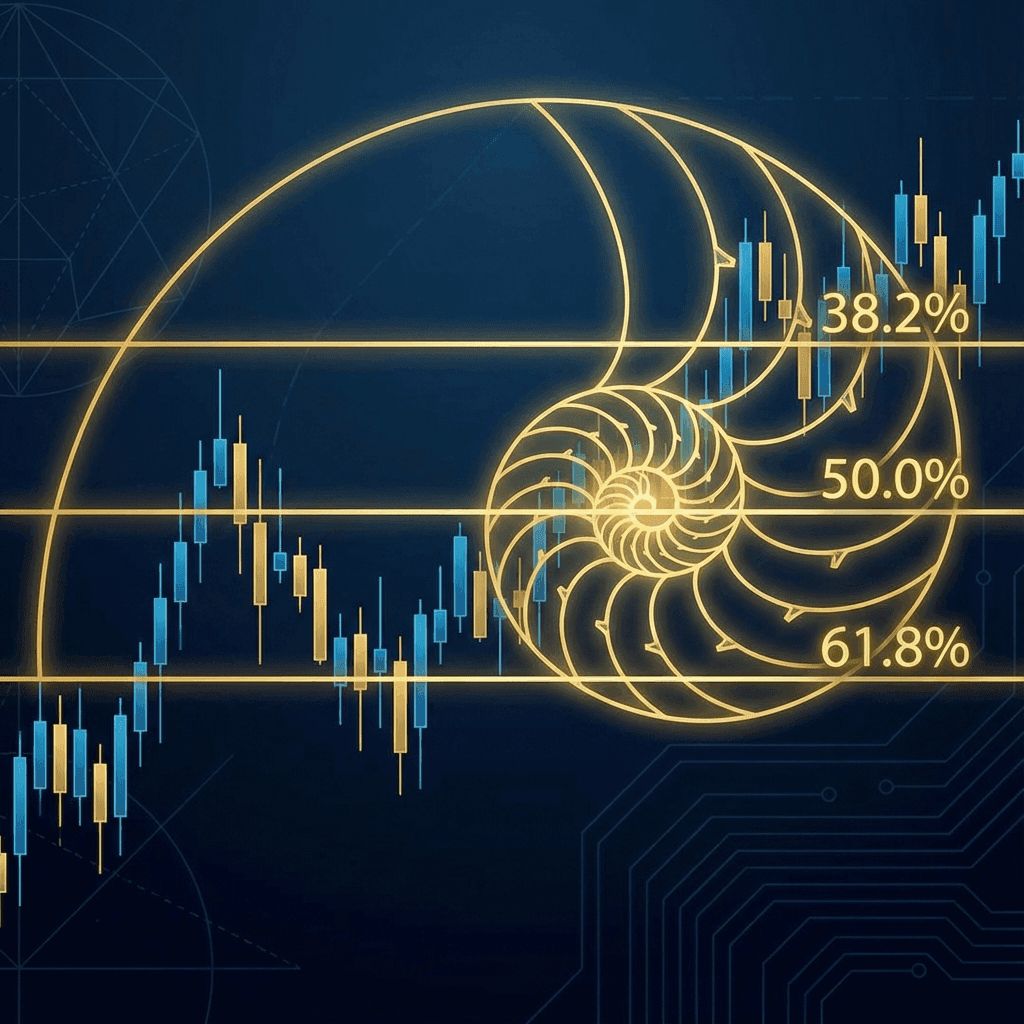





Key Takeaways
- Fibonacci Retracement levels are horizontal lines indicating where support and resistance are likely to occur.
- They are based on the Golden Ratio (1.618) found throughout nature and financial markets.
- Key Levels: 23.6%, 38.2%, 50%, 61.8% (Golden Pocket), and 78.6%.
- Trading Strategy: In an uptrend, wait for price to retrace to the 50% or 61.8% level, then buy.
- Fibonacci Extensions (127.2%, 161.8%) provide profit targets beyond the original move.
- Fibs work because millions of traders watch the same levels, making them self-fulfilling.
Table of Contents
What is Fibonacci in Trading?
Is the market ruled by mathematics? The Fibonacci sequence suggests yes. From the spiral of galaxies to the petals of flowers, this mathematical ratio appears everywhere in nature—including financial charts.
In trading, Fibonacci retracement is a technical analysis tool that uses horizontal lines to indicate where support and resistance levels are likely to occur. These levels are derived from the Fibonacci sequence and help traders identify potential entry and exit points.
Why does Fibonacci work in trading? Partly psychology, partly self-fulfilling prophecy. When millions of traders worldwide watch the same levels, their collective buying and selling at those prices creates the very support and resistance that makes Fibonacci effective.
The Golden Ratio Explained
The Fibonacci sequence was discovered by the Italian mathematician Leonardo Fibonacci in the 12th century. The sequence starts with 0 and 1, and each subsequent number is the sum of the two preceding ones:
0, 1, 1, 2, 3, 5, 8, 13, 21, 34, 55, 89, 144, 233...
Each number is approximately 1.618 times the previous number. This ratio (1.618) is called the Golden Ratio or Phi (φ).
Deriving the Key Levels
The trading levels are derived from relationships within this sequence:
- 61.8%: Divide any number by the next number (e.g., 55 ÷ 89 = 0.618)
- 38.2%: Divide any number by the number two places to the right (e.g., 55 ÷ 144 = 0.382)
- 23.6%: Divide any number by the number three places to the right (e.g., 55 ÷ 233 = 0.236)
- 50%: Not technically a Fibonacci number, but included due to Dow Theory and psychology
Key Fibonacci Levels
These are the standard Fibonacci retracement levels you'll find on every trading platform:
| Level | Significance |
|---|---|
| 23.6% | Shallow retracement. Strong trends often only pull back this far. |
| 38.2% | First meaningful retracement level. Good for momentum trades. |
| 50.0% | Psychological level. "Halfway back" often acts as support/resistance. |
| 61.8% | The Golden Pocket. Most watched level. Highest probability reversal zone. |
| 78.6% | Deep retracement. Last chance for the trend to continue. |
The 61.8% level (often called the "Golden Pocket" when combined with 65%) is the most significant. Many professional traders focus exclusively on this zone for entries.
How to Draw Fibonacci Retracements
Drawing Fibonacci retracements correctly is essential. Here's how to do it:
In an Uptrend (Looking for Buy Opportunities)
- Click on the Swing Low (the lowest point before the move up)
- Drag the tool to the Swing High (the highest point of the move)
- The retracement levels will appear below the high
- Look to buy when price retraces to 50% or 61.8%
In a Downtrend (Looking for Sell Opportunities)
- Click on the Swing High (the highest point before the move down)
- Drag the tool to the Swing Low (the lowest point of the move)
- The retracement levels will appear above the low
- Look to sell when price retraces up to 50% or 61.8%
Important: Use significant swing points, not minor fluctuations. The larger and cleaner the initial move, the more reliable the Fibonacci levels will be.
Trading the 50% and 61.8% Levels
Markets rarely move in a straight line. After a strong move, profit-taking and counter-trend traders cause a pullback (retracement). Understanding where this pullback is likely to end allows you to enter in the direction of the trend at a discount.
The 50% Level
While not technically a Fibonacci number, the 50% level is psychologically significant. It represents the idea that price has retraced "halfway back." Many traders, especially beginners, watch this level closely.
The 61.8% Level (Golden Pocket)
The 61.8% level is the most powerful Fibonacci level. When price reaches this zone:
- Professional traders are looking to enter
- It offers excellent risk-to-reward (tight stop below 78.6%)
- If this level fails, the original trend is likely invalidated
The "Golden Pocket" is the zone between 61.8% and 65%. Many traders consider this the highest probability reversal area.
Fibonacci Extensions for Targets
While retracements help with entries, Fibonacci Extensions help with exits. They project levels beyond the original move to identify profit targets.
Key Extension Levels
- 127.2%: Conservative first target
- 161.8%: The Golden Extension. Primary profit target for many traders.
- 200.0%: Full measured move
- 261.8%: Extended target in strong trends
Using Extensions for Profit Targets
If you enter at the 61.8% retracement, you might set your first target at the 127.2% extension and your second target at the 161.8% extension. This provides clear exit points based on the same Fibonacci mathematics.
Fibonacci Confluence
Confluence means multiple trading signals or levels aligning at the same price. When Fibonacci levels align with other technical factors, the probability of a reversal increases significantly.
What to Look For
- Horizontal Support/Resistance: Fib level + previous Support/Resistance level
- Moving Averages: Fib level + 50 or 200 EMA
- Trendlines: Fib level + ascending/descending trendline
- Round Numbers: Fib level + psychological price (1.1000, 1.2000)
- Multiple Timeframe Fibs: Daily and H4 Fibonacci levels overlapping
A 61.8% retracement that also aligns with the 200 EMA and a previous support level is a high-probability trade setup.
Fibonacci Trading Strategies
Strategy 1: Fib Retracement Entry
The most common Fibonacci strategy:
- Identify a clear trend (uptrend or downtrend)
- Draw Fibonacci from swing low to swing high (uptrend) or high to low (downtrend)
- Wait for price to retrace to the 50-61.8% zone
- Enter with a bullish/bearish candlestick confirmation
- Stop-loss below the 78.6% level (or recent swing)
- Target: 127.2% and 161.8% extensions
Strategy 2: Fib Cluster Trading
Draw Fibonacci retracements from multiple swings on the same chart:
- Identify 2-3 significant swing moves
- Draw Fibonacci on each
- Look for areas where multiple Fib levels cluster together
- These "cluster zones" are high-probability reversal areas
Strategy 3: Fib + RSI Divergence
Combine Fibonacci with the RSI indicator:
- Price retraces to the 61.8% level
- RSI shows bullish divergence (in an uptrend) or bearish divergence (in a downtrend)
- Enter on confirmation with tight stop-loss
- This combination significantly increases win rate
Frequently Asked Questions
Is the 50% level really a Fibonacci number?
Technically, no. 50% is not derived from the Fibonacci sequence. However, it's included in every Fib tool because of its psychological significance (Dow Theory's "halfway back" concept). Traders watch it, so it works.
What happens if price breaks the 61.8% level?
If price breaks convincingly below the 61.8% (and especially the 78.6% level), the original trend is likely invalidated. This is often used as the stop-loss area. At that point, look for reversal setups in the opposite direction.
Can I use Fibonacci on any timeframe?
Yes, Fibonacci works on all timeframes. However, levels on higher timeframes (Daily, Weekly) tend to be more significant than on lower timeframes (M5, M15). Many traders use multiple timeframe analysis, looking for Fib confluence.
Which Fibonacci tool should I use: Retracement or Extension?
Use Retracements for entries (finding where pullbacks might end) and Extensions for targets (finding where price might go after resuming the trend). Most traders use both together for complete trade management.
Why does Fibonacci work in trading?
A combination of self-fulfilling prophecy and natural market psychology. When millions of traders watch the same levels and place orders there, those levels become significant. Additionally, human behavior naturally follows patterns that mirror Fibonacci proportions.
Should I trade every Fibonacci level?
No. Focus on the 50-61.8% zone (the "Golden Pocket") for the highest probability trades. Always look for confluence with other factors before entering. Quality over quantity wins in trading.
For deeper comparison, review our best forex brokers, check individual broker reviews, use the Match Me to a Broker quiz, and calculate risk with the position size calculator.