Trading Academy
 Forex Glossary
 Trading Guides
 News
News Blog
Blog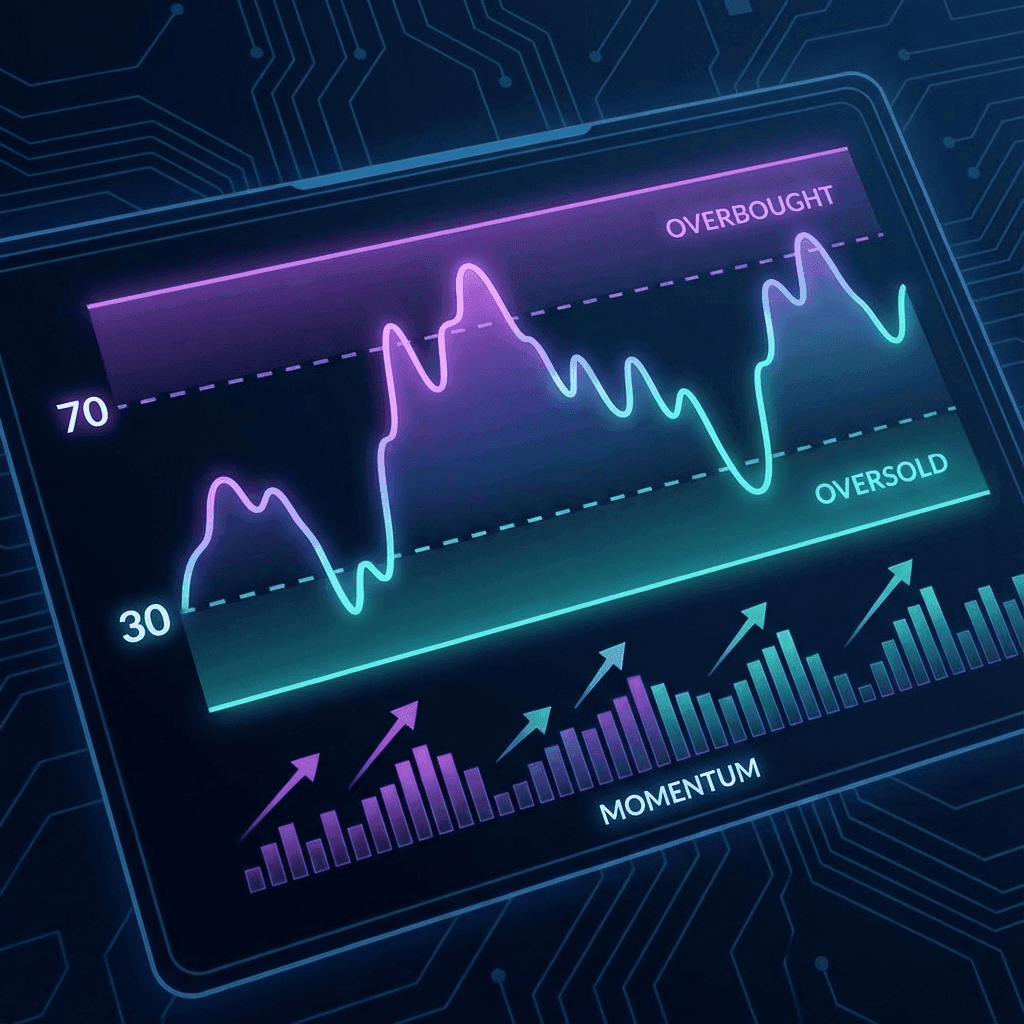
.0e1c6179.jpg&w=96&q=75)




Key Takeaways
- RSI (Relative Strength Index) measures the speed and magnitude of price changes on a scale of 0-100.
- Overbought: RSI above 70 suggests price may be stretched too high and due for a pullback.
- Oversold: RSI below 30 suggests price may be stretched too low and due for a bounce.
- RSI Divergence is the secret weapon—when price makes a new high but RSI makes a lower high, reversals often follow.
- In strong trends, RSI can remain overbought/oversold for extended periods—don't trade against the trend blindly.
- Developed by J. Welles Wilder Jr. in 1978, RSI remains one of the most used indicators globally.
Table of Contents
What is RSI?
The Relative Strength Index (RSI) is a momentum oscillator that measures the speed and magnitude of recent price changes to evaluate overbought or oversold conditions. Created by technical analysis legend J. Welles Wilder Jr. in 1978, it has become one of the most widely used indicators in all of trading.
RSI oscillates between 0 and 100, providing a clear visual representation of momentum. Unlike trend-following indicators that tell you which direction price is moving, RSI tells you how strong that movement is and whether it might be reaching exhaustion.
In this guide, we'll explore everything from basic overbought/oversold readings to advanced divergence techniques that professional traders use to spot reversals before they happen.
How RSI is Calculated
Understanding the formula helps you understand what RSI is actually measuring:
RSI = 100 - (100 / (1 + RS))
Where RS (Relative Strength) = Average Gain / Average Loss over the period
The standard period is 14 (14 candles). RSI compares the magnitude of recent gains to recent losses, expressing this as a percentage.
In plain English: If the last 14 candles have been mostly bullish (more and larger green candles), RSI will be high. If they've been mostly bearish, RSI will be low. The indicator essentially measures "how aggressively" the market has been moving in one direction.
Overbought vs Oversold
The most basic RSI application uses two threshold levels:
| RSI Level | Condition | Interpretation |
|---|---|---|
| Above 70 | Overbought | Price may be overstretched to the upside; potential for pullback |
| 50 (Centerline) | Neutral | Balanced momentum; often used as trend filter |
| Below 30 | Oversold | Price may be overstretched to the downside; potential for bounce |
⚠️ Critical Warning
Overbought does NOT mean "sell" and oversold does NOT mean "buy"! In strong trends, RSI can remain in overbought or oversold territory for extended periods. Trading against the trend just because RSI hit 70 or 30 is a common mistake that leads to losses.
RSI Divergence - The Secret Weapon
RSI Divergence is arguably the most powerful signal this indicator provides. Divergence occurs when price and RSI move in opposite directions—a sign that momentum is weakening despite what the price chart shows.
Bearish Divergence
- Price makes a higher high
- RSI makes a lower high
- Signal: Momentum is weakening despite rising prices
- Implication: Potential reversal to the downside
Bullish Divergence
- Price makes a lower low
- RSI makes a higher low
- Signal: Selling pressure is weakening despite falling prices
- Implication: Potential reversal to the upside
Divergence signals are most reliable when RSI is simultaneously in overbought (for bearish) or oversold (for bullish) territory. The combination of extreme readings plus divergence creates high-probability reversal setups.
Centerline Crossover Strategy
Many traders overlook the 50 level (centerline), but it's extremely useful as a trend filter:
- RSI above 50: Bullish momentum dominates—look for long opportunities only.
- RSI below 50: Bearish momentum dominates—look for short opportunities only.
- Crossing above 50: Potential confirmation of new uptrend.
- Crossing below 50: Potential confirmation of new downtrend.
This simple filter can dramatically improve your win rate by keeping you aligned with the dominant momentum. Professional forex brokers provide platforms with customizable RSI alerts for centerline crosses.
Failure Swings
Failure swings are reversal signals that occur entirely within the RSI indicator, without requiring confirmation from price divergence. Wilder considered these more reliable than divergence.
Bullish Failure Swing (Bottom)
- 1. RSI drops below 30 (oversold)
- 2. RSI bounces above 30
- 3. RSI pulls back but stays above 30
- 4. RSI breaks above its previous high → BUY signal
Bearish Failure Swing (Top)
- 1. RSI rises above 70 (overbought)
- 2. RSI drops below 70
- 3. RSI bounces but fails to break above 70
- 4. RSI drops below its previous low → SELL signal
Optimal RSI Settings
While 14 periods is standard, you can adjust based on your trading style:
| Trading Style | Period | Levels | Character |
|---|---|---|---|
| Scalping | 7-9 | 80/20 | Fast, more signals, more noise |
| Day Trading | 14 | 70/30 | Standard, balanced |
| Swing Trading | 21-25 | 60/40 | Slow, fewer but stronger signals |
Some traders use 80/20 levels instead of 70/30 for more extreme (and thus more reliable) overbought/oversold signals. Experiment to find what works best for your strategy.
Combining RSI with Other Tools
RSI works best in combination with other analysis methods:
- Support/Resistance: RSI oversold at major support = stronger buy signal.
- Moving Averages: RSI above 50 + price above 200 MA = strong uptrend confirmation.
- Candlestick Patterns: RSI divergence + bullish engulfing = high-probability reversal.
- MACD: RSI divergence confirmed by MACD divergence = very strong signal.
- Bollinger Bands: RSI oversold + price at lower Bollinger Band = confluence.
For advanced analysis with multiple indicators, consider MT5 brokers that offer extensive charting capabilities.
Frequently Asked Questions
Is RSI a leading or lagging indicator?
RSI is considered a "leading" indicator when divergence is present, as it can signal reversals before they appear on the price chart. However, for basic overbought/oversold readings, it's more of a "confirming" indicator.
Can I use RSI for scalping?
Yes! Use a shorter period (7-9) and consider using 80/20 levels instead of 70/30. Combine with price action for entries. Scalping brokers with low latency are essential for quick RSI-based trades.
Why does RSI stay overbought in uptrends?
In strong trends, buying pressure remains consistently high, keeping RSI elevated. This is normal and actually confirms trend strength. Don't short just because RSI is "overbought"—wait for bearish divergence or price structure breaks first.
What's the difference between regular and hidden divergence?
Regular divergence signals potential reversals (covered above). Hidden divergence signals trend continuation—for example, in an uptrend, price makes a higher low while RSI makes a lower low. This suggests the pullback is over and the trend will resume.
Should I use RSI on multiple timeframes?
Absolutely! Multi-timeframe RSI analysis is powerful. For example, only take buy signals on the 1-hour chart when the daily RSI is above 50 (confirming bullish momentum on the higher timeframe).
Is the 14-period RSI the best setting?
It's the most tested and reliable, but not necessarily "best" for everyone. Shorter periods are more sensitive (good for shorter-term trading), while longer periods are smoother (better for swing trading). Test different settings on your chosen pairs.
.0e1c6179.jpg&w=1920&q=75)