Trading Academy
 Forex Glossary
 Trading Guides
 News
News Blog
Blog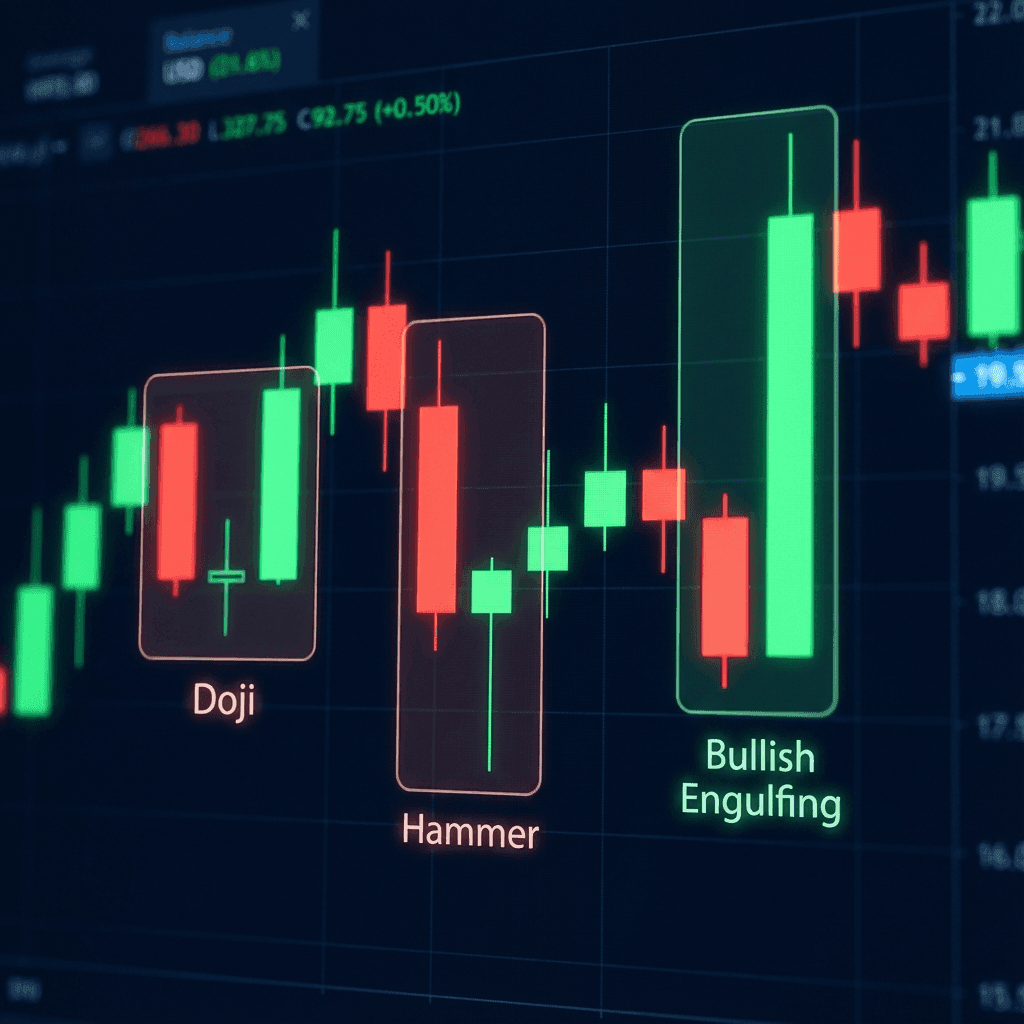





Key Takeaways
- Japanese candlestick patterns provide visual insight into the battle between buyers and sellers within each time period.
- Reversal patterns (Hammer, Engulfing, Doji) signal potential trend changes and are most powerful at key support/resistance levels.
- Continuation patterns (Three White Soldiers, Rising Three Methods) confirm the current trend will likely continue.
- Context is everything—never trade a candlestick pattern in isolation. Always consider the surrounding market structure.
- Higher timeframe patterns (Daily, Weekly) are significantly more reliable than lower timeframe patterns (M1, M5).
Table of Contents
Over 300 years ago, Japanese rice traders developed a charting technique that would eventually revolutionize how we analyze financial markets. Japanese candlestick charts provide more visual information than traditional bar or line charts, making it easier to spot potential reversals and trading opportunities at a glance.
Unlike simple lines that show only closing prices, candlesticks reveal the complete story of each trading period: where price opened, where it closed, how high it reached, and how low it fell. This wealth of information, presented in an intuitive visual format, makes candlestick analysis an essential skill for any serious forex trader.
Historical Note: Candlestick charts were invented by Munehisa Homma, a legendary Japanese rice trader in the 1700s. His techniques were so successful that he became one of the wealthiest men in Japan.
What Are Japanese Candlesticks?
A candlestick is a graphical representation of price movement within a specific time period (1 minute, 1 hour, 1 day, etc.). Each candlestick shows four key prices: the Open, High, Low, and Close—often abbreviated as OHLC.
Bullish Candle (Green/White)
When the close is higher than the open, the candle is bullish. This indicates buyers were in control during that period. The body is typically colored green or white.
Bearish Candle (Red/Black)
When the close is lower than the open, the candle is bearish. This indicates sellers dominated that period. The body is typically colored red or black.
Anatomy of a Candlestick
Every candlestick has two main parts: the body and the wicks (also called shadows). Understanding these components is essential for reading candlestick patterns.
The Body
- Long Body: Strong conviction—one side completely dominated the session
- Short Body: Indecision—neither buyers nor sellers gained significant ground
- No Body (Doji): Perfect indecision—open and close are virtually the same
The Wicks (Shadows)
- Upper Wick: Shows the highest price reached—long upper wick means rejection from highs
- Lower Wick: Shows the lowest price reached—long lower wick means rejection from lows
- No Wick: Called a Marubozu—full commitment from one side
Single Candlestick Patterns
These patterns consist of just one candlestick and can provide powerful reversal signals when they appear at key levels.
Hammer / Hanging Man
A Hammer has a small body at the top with a long lower wick (at least 2x the body length) and little to no upper wick. It signals a potential bullish reversal when it appears at the bottom of a downtrend.
- Hammer (Bullish): Appears after a downtrend—sellers pushed price down but buyers rejected lows
- Hanging Man (Bearish): Same shape but appears after an uptrend—warning sign of potential reversal
Best Use: At key support levels for hammers, key resistance for hanging man.
Shooting Star / Inverted Hammer
The opposite of the hammer—small body at the bottom with a long upper wick. The Shooting Star appears after an uptrend and signals potential bearish reversal.
- Shooting Star (Bearish): After an uptrend—buyers pushed price up but sellers rejected highs
- Inverted Hammer (Bullish): Same shape but after a downtrend—potential buying interest emerging
Doji Patterns
A Doji forms when the open and close are virtually the same, creating a cross or plus sign shape. It represents perfect indecision in the market.
Standard Doji
Equal wicks—complete balance
Dragonfly Doji
Long lower wick—bullish at support
Gravestone Doji
Long upper wick—bearish at resistance
Marubozu
A Marubozu is a candle with no wicks at all—just a body. This indicates absolute dominance by one side. A bullish Marubozu (green) shows buyers controlled the entire session from open to close with no pushback from sellers. Very strong momentum signal.
Double Candlestick Patterns
These patterns require two consecutive candlesticks to form. They often provide stronger signals than single candlestick patterns.
Bullish Engulfing
A Bullish Engulfing pattern occurs when a large green candle completely "engulfs" the previous smaller red candle. The body of the second candle must completely cover the body of the first.
Signal: Strong bullish reversal, especially powerful at support levels. Indicates buyers have overwhelmed sellers.
Bearish Engulfing
The opposite—a large red candle completely engulfs the previous smaller green candle. This signals a potential bearish reversal at the top of an uptrend.
Signal: Strong bearish reversal, most effective at resistance levels.
Piercing Line / Dark Cloud Cover
Piercing Line (Bullish): After a bearish candle, a bullish candle opens below the low but closes above 50% of the previous candle's body.
Dark Cloud Cover (Bearish): The opposite—after a bullish candle, a bearish candle opens above the high but closes below 50% of the previous body.
Tweezer Tops & Bottoms
Tweezer patterns form when two consecutive candles have matching highs (Tweezer Top) or matching lows (Tweezer Bottom). They indicate that price tried to go beyond a level twice and failed—strong rejection signal.
Triple Candlestick Patterns
These patterns involve three consecutive candles and are often considered more reliable due to the additional confirmation.
Three White Soldiers
Three consecutive long bullish candles, each opening within the previous body and closing higher. Strong bullish reversal pattern.
Warning: If the candles have very long bodies with small wicks, be cautious of overextension.
Three Black Crows
Three consecutive long bearish candles, each opening within the previous body and closing lower. Strong bearish reversal pattern.
Confirmation: Most powerful after an extended uptrend at resistance.
Morning Star & Evening Star
Morning Star (Bullish)
- Long bearish candle
- Small-bodied candle (gap down)
- Long bullish candle that closes above 50% of candle 1
Evening Star (Bearish)
- Long bullish candle
- Small-bodied candle (gap up)
- Long bearish candle that closes below 50% of candle 1
Context is King
A hammer candlestick appearing randomly in the middle of a chart means almost nothing. The same hammer appearing at a major support level after a prolonged downtrend is a tradeable signal. Context transforms patterns from noise into opportunities.
Where is it?
Patterns at support/resistance levels are more significant than patterns in "no man's land."
What's the trend?
Reversal patterns are more reliable after extended trends. Bullish patterns need a preceding downtrend to reverse.
What timeframe?
A Daily engulfing pattern is far more significant than a 5-minute engulfing pattern. Focus on H4 and above.
Is there confluence?
Combine with Fibonacci levels, moving averages, or other technical tools for confirmation.
Pattern Quick Reference Table
| Pattern | Type | Candles | Signal | Strength |
|---|---|---|---|---|
| Hammer | Reversal | 1 | Bullish | ⭐⭐⭐⭐ High |
| Shooting Star | Reversal | 1 | Bearish | ⭐⭐⭐⭐ High |
| Doji | Reversal | 1 | Neutral | ⭐⭐⭐ Medium |
| Bullish Engulfing | Reversal | 2 | Bullish | ⭐⭐⭐⭐⭐ Very High |
| Bearish Engulfing | Reversal | 2 | Bearish | ⭐⭐⭐⭐⭐ Very High |
| Morning Star | Reversal | 3 | Bullish | ⭐⭐⭐⭐⭐ Very High |
| Evening Star | Reversal | 3 | Bearish | ⭐⭐⭐⭐⭐ Very High |
| Three White Soldiers | Continuation | 3 | Bullish | ⭐⭐⭐⭐ High |
Practice Makes Perfect
The best way to internalize candlestick patterns is through deliberate practice. Open charts on a regulated broker's platform and try to identify patterns on historical data before looking at what happened next.
Find a Practice PlatformFrequently Asked Questions
Do candlestick patterns work in forex?
Yes, candlestick patterns are widely used in forex trading. They're particularly effective on the Daily, H4, and H1 timeframes. However, because forex trades 24/5, true gaps are rare outside of weekend openings.
What is the most reliable candlestick pattern?
The Bullish and Bearish Engulfing patterns are considered among the most reliable, especially when they occur at key support or resistance levels with increased volume. The Morning/Evening Star patterns are also highly reliable three-candle formations.
Can I trade only using candlestick patterns?
While some traders do focus primarily on candlesticks (price action trading), most successful traders combine candlestick patterns with other analysis tools like support/resistance, trend analysis, and risk management principles.
Which timeframe is best for candlestick patterns?
Higher timeframes produce more reliable patterns. The Daily chart is considered the gold standard for candlestick analysis. H4 is also good. Patterns on M1, M5, or M15 are generally unreliable due to market noise.
How do I confirm a candlestick signal?
Wait for additional confirmation before entering: (1) Look for the pattern at a key level, (2) Check if volume supports the move, (3) Wait for the next candle to confirm the direction, (4) Use indicators like RSI for confluence.