Trading Academy
 Forex Glossary
 Trading Guides
 News
News Blog
Blog





Key Takeaways
- Risk management is the single most important factor for long-term survival and success in forex trading.
- The 1-2% Rule: Never risk more than 1-2% of your account capital on a single trade.
- Always use a Stop-Loss order to protect against catastrophic losses—trading without one is like driving without brakes.
- Understand Position Sizing: Calculate your lot size based on stop-loss distance and risk percentage.
- Use a positive Risk-Reward Ratio (e.g., 1:2 or 1:3) to stay profitable even with a lower win rate.
- High leverage is a tool, not a strategy—use it responsibly to avoid margin calls.
Table of Contents
Why Risk Management is Everything
You can have the best trading strategy in the world, but without proper risk management in forex, you will eventually blow up your account. This isn't pessimism—it's statistical reality. Market movements are unpredictable, and even the best traders experience losing streaks.
Risk management is about ensuring that when you are wrong—and you will be wrong often—you lose small. And when you are right, you win big. The goal isn't to eliminate losses (that's impossible), but to survive long enough to let your edge play out over hundreds of trades.
Consider this sobering math: If you risk 10% per trade and have 5 consecutive losses (which happens more often than you think), you've lost 41% of your account. But if you risk only 1% per trade, that same losing streak only costs you about 5%. The difference is staying in the game versus going bust.
The 1-2% Rule Explained
The 1-2% rule is the foundation of professional risk management. It states that you should never risk more than 1-2% of your total account balance on any single trade.
Why 1-2%?
- Survival: Even with 20 consecutive losses (rare but possible), you still have 82% of your account at 1% risk.
- Psychological Comfort: Smaller losses are easier to accept, reducing emotional trading decisions.
- Compounding: Small, consistent gains compound faster than boom-and-bust cycles.
- Professional Standard: Hedge funds and professional traders typically risk 0.25-2% per trade.
Example Calculation
If your account is $10,000 and you follow the 1% rule:
- Maximum risk per trade = $10,000 × 1% = $100
- This means your stop-loss should never represent more than $100 of potential loss
- Your position size is then calculated backwards from this $100 risk limit
Position Sizing: The Golden Rule
Most beginners make the mistake of trading a fixed lot size (e.g., "I always trade 0.1 lots"). This is dangerous because stop-loss distances vary from trade to trade. A 50-pip stop requires a different position size than a 100-pip stop to maintain the same dollar risk.
The Position Sizing Formula
Proper position sizing means calculating your lot size based on:
Position Size = (Account Size × Risk %) ÷ (Stop Loss in Pips × Pip Value)
Example: $10,000 account, 1% risk, 50 pip stop on EUR/USD = ($10,000 × 0.01) ÷ (50 × $10) = 0.2 lots
Variables in Position Sizing
- Account Size: Your total account balance
- Risk Percentage: 1% or 2% of your account
- Stop Loss Distance: Number of pips from entry to stop-loss
- Pip Value: Varies by currency pair and lot size (standard lot EUR/USD = $10/pip)
Many trading platforms have built-in position size calculators, or you can use online tools. Never skip this step. See our guide on forex lot sizes for more details.
Stop-Loss and Take-Profit Orders
A Stop-Loss (SL) is an order that automatically closes your trade if the price moves against you by a set amount. Trading without a stop-loss is like driving a car without brakes—you might be fine for a while, but eventually, disaster will strike.
Types of Stop-Losses
- Fixed Stop: Set at a specific price level based on technical analysis (support/resistance, ATR, etc.).
- Trailing Stop: Moves with the price to lock in profits as the trade moves in your favor.
- Mental Stop: A price level where you plan to exit, but no actual order is placed. Risky—emotions can override your plan.
- Guaranteed Stop-Loss (GSLO): Offered by some brokers for a premium; guarantees execution at your price even during gaps.
Take-Profit Orders
A Take-Profit (TP) order secures your gains when the price reaches your target. It removes emotion from the exit decision and prevents greed from turning a winner into a loser.
Pro Tip: Consider using multiple take-profit levels. For example, close 50% at the first target and let the rest run with a trailing stop. This locks in profits while allowing for larger moves.
Understanding Risk-Reward Ratio
The Risk-Reward Ratio (RRR) measures how much you are risking compared to how much you plan to gain. A ratio of 1:2 means you risk $100 to potentially make $200.
Why RRR Matters
With a 1:2 risk-reward ratio, you only need to be right 34% of the time to break even.
This takes a massive amount of pressure off your win rate and allows for more conservative, high-probability setups.
Common Risk-Reward Ratios
- 1:1 (Not Recommended): You need a 50%+ win rate just to break even after costs.
- 1:2 (Good): You need 34% win rate to break even. Room for error.
- 1:3 (Excellent): You need 25% win rate to break even. Very forgiving.
Always ensure your potential reward justifies the risk before entering a trade. If you can't find at least a 1:2 setup, consider waiting for a better opportunity.
The Dangers of Leverage
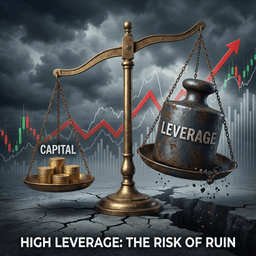
Leverage allows you to control large positions with small capital. While high leverage brokers offer ratios like 1:500 or even 1:1000, using maximum leverage is a recipe for disaster.
The Leverage Trap
High leverage amplifies both gains AND losses. A 100-pip move against your position can wipe out your account if you're overleveraged. The European ESMA regulations cap retail forex leverage at 1:30 for good reason—to protect traders from themselves.
Effective vs. Available Leverage
Just because 1:500 leverage is available doesn't mean you should use it. Effective leverage is what actually matters—it's the ratio of your total position size to your account equity.
- Conservative: 1:1 to 1:5 effective leverage
- Moderate: 1:5 to 1:10 effective leverage
- Aggressive: 1:10 to 1:20 effective leverage
- Dangerous: Above 1:20 effective leverage
Professional traders typically use effective leverage of no more than 1:10, regardless of how much leverage their broker offers.
Managing Drawdowns
A drawdown is the peak-to-trough decline in your account value before a new peak is achieved. All traders experience drawdowns—the key is managing them.
Drawdown Recovery Math
| Drawdown | Gain Needed to Recover |
|---|---|
| 10% | 11% |
| 20% | 25% |
| 30% | 43% |
| 50% | 100% |
| 75% | 300% |
As you can see, larger drawdowns become increasingly difficult to recover from. A 50% drawdown requires a 100% gain just to get back to break even. This is why risk management and the 1-2% rule are so critical.
Psychology and Discipline
Risk management isn't just about numbers—it's about psychology. The best risk management system is worthless if you don't have the discipline to follow it.
Common Psychological Pitfalls
- Revenge Trading: Trying to win back losses immediately by taking larger risks.
- Moving Stop-Losses: Widening your stop as price approaches it, hoping for a reversal.
- Averaging Down: Adding to losing positions without a predefined strategy.
- Overtrading: Taking low-quality setups out of boredom or greed.
- FOMO: Fear of missing out, leading to impulsive entries.
Solution: Create a detailed trading plan and treat it like law. Journal your trades to identify emotional patterns. Consider stepping away from the screen during losing streaks.
Frequently Asked Questions
What is the 1% rule in forex?
The 1% rule states that you should never risk more than 1% of your total account balance on a single trade. If you have $10,000, your maximum loss on any trade should be $100.
Can I trade without a stop-loss?
It is strongly discouraged. Volatility spikes, internet disconnections, or broker outages can leave you exposed to unlimited losses. Some traders use mental stops, but these are vulnerable to emotional overrides.
What is hedging in forex?
Hedging involves opening a position to offset the risk of another. For example, opening a Sell on EUR/USD to protect a Buy position during volatile news. It's a risk management technique, not a profit strategy.
How do I calculate my maximum position size?
Use the formula: Position Size = (Account Balance × Risk %) ÷ (Stop-Loss Pips × Pip Value). For example, $10,000 × 1% ÷ (50 pips × $10) = 0.2 lots on EUR/USD.
What is a good risk-reward ratio?
Most professional traders aim for at least 1:2 (risk $1 to make $2). This allows for profitability even with a win rate below 50%. Higher ratios like 1:3 are even better but may result in fewer trades.
How much leverage should I use?
Effective leverage of 1:5 to 1:10 is considered moderate and appropriate for most traders. Using more than 1:20 effective leverage is generally too aggressive and increases the risk of account blowups.
For deeper comparison, review our best forex brokers, check individual broker reviews, use the Match Me to a Broker quiz, and calculate risk with the position size calculator.