Trading Academy
 Forex Glossary
 Trading Guides
 News
News Blog
Blog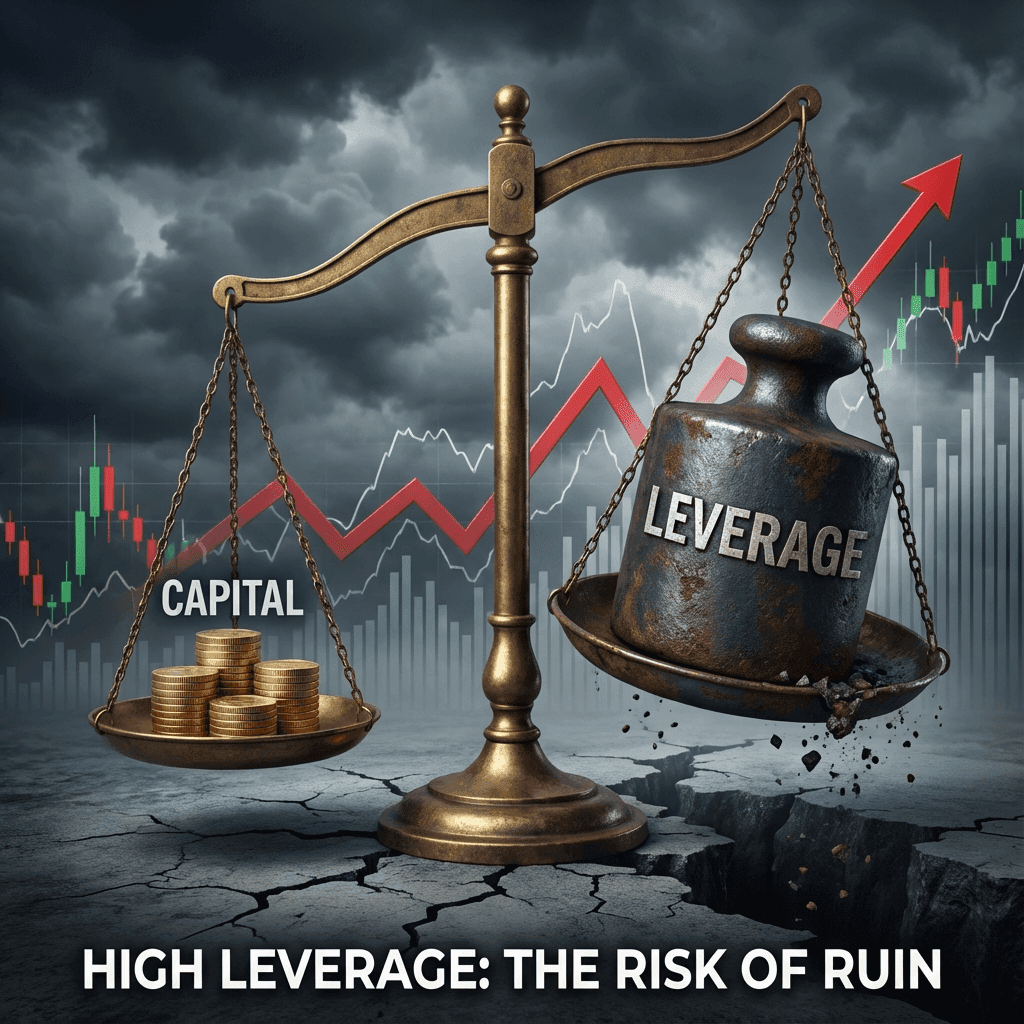





Key Takeaways
- Leverage is Credit: It is borrowed money. 1:100 means for every $1 you have, the broker lends you $99.
- The Multiplier Effect: Leverage multiplies both your wins AND your losses. It does not change the probability of the trade, only the speed of the result.
- Margin Call: The point of no return. If your equity falls below the maintenance margin (usually 50-100%), the broker forcibly closes your trades to save their capital.
- Negative Balance: In extreme events (like Black Swans), you can lose MORE than you deposited. Always use a broker with Negative Balance Protection (NBP).
Table of Contents
The Seducation of High Leverage
"Turn $100 into $1,000!" This is the marketing cry of offshore brokers offering 1:1000 or 1:3000 leverage.
Reality: High leverage is not a tool for growth; it is a tool for gambling. It reduces your "Margin for Error" to zero.
The Math of Ruin
Let's compare two traders with $1,000.
- Trader A (1:30): Buys 0.3 Lots EURUSD. Price drops 1% (100 pips). Loss = $300. Account = $700. He survives.
- Trader B (1:500): Buys 5.0 Lots EURUSD. Price drops 0.2% (20 pips). Loss = $1,000. Account = $0. He is liquidated.
The market moves 20 pips in 5 minutes. Trader B lasted 5 minutes.
Understanding Margin Calls
When your Margin Level % drops below the broker's threshold (Stop Out Level), the robot takes over.
Stop Out Level 50%: If you have $100 used margin, and your equity falls to $50, the trade is closed instantly.
Always calculate your "Survivable Drawdown" in pips before entering.
Negative Balance Protection
Imagine the Swiss Franc crash of 2015. Price jumped 2000 pips in a second. Stop losses were skipped.
Traders who had $1,000 in their account suddenly had -$5,000. They owed the broker.
Protection: Top regulators (FCA, ASIC, ESMA) mandate Negative Balance Protection. This means the broker eats the loss, not you. Your balance cannot go below zero.
Frequently Asked Questions
What is the best leverage for a beginner?
1:10 to 1:30. This restricts you from opening massive positions that can wipe you out in minutes.
Can I change my leverage?
Yes, most brokers allow you to change leverage in the client portal. We highly recommend lowering it manually to protect yourself from yourself. See our Risk Management Guide.
For deeper comparison, review our best forex brokers, check individual broker reviews, use the Match Me to a Broker quiz, and calculate risk with the position size calculator.