Trading Academy
 Forex Glossary
 Trading Guides
 News
News Blog
Blog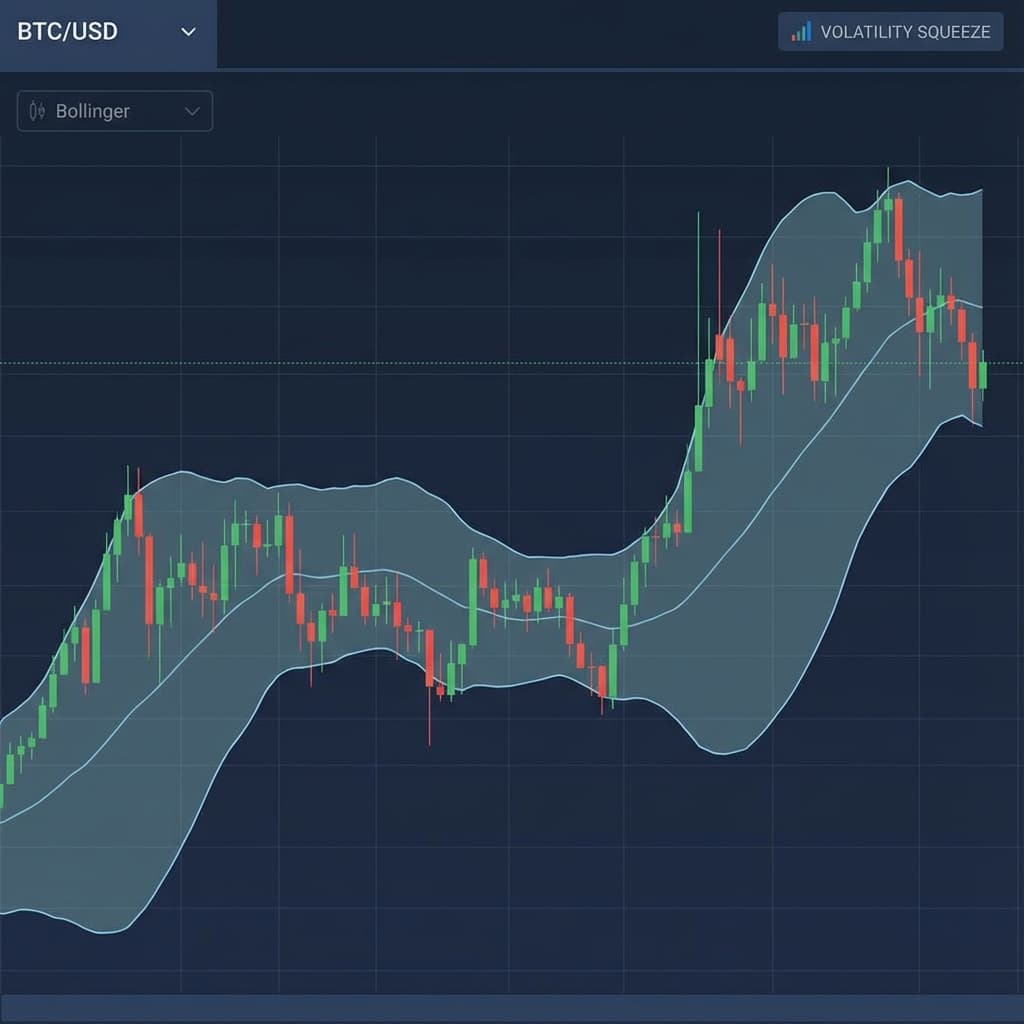





Key Takeaways
- Bollinger Bands consist of a middle Moving Average and two "standard deviation" bands that expand and contract with volatility.
- The Squeeze: When bands get extremely tight, prepare for a massive volatility breakout.
- Mean Reversion: In ranging markets, price tends to return to the middle band after touching outer bands.
- Walking the Bands: In strong trends, price can "walk" along the upper or lower band for extended periods.
- Combine Bollinger Bands with other indicators like RSI for confirmation and better accuracy.
- Developed by John Bollinger in the 1980s—still one of the most popular indicators today.
Table of Contents
What Are Bollinger Bands?
Markets move in cycles of silence and explosion—periods of low volatility consolidation followed by high volatility breakouts. Bollinger Bands are the perfect tool to visualize this "volatility breath." They act like a rubber band around the price—stretching when things get wild and snapping back when things calm down.
Developed by legendary technical analyst John Bollinger in the 1980s, this indicator has become one of the most widely used tools in trading. Unlike simple moving averages that only show trend direction, Bollinger Bands dynamically adapt to market conditions, making them invaluable for identifying trading opportunities.
In this comprehensive guide, we'll explore how to read, interpret, and trade Bollinger Bands across different market conditions—from calm consolidations to explosive breakouts.
The 3 Bands Explained
Bollinger Bands consist of three lines that envelop price action:
- Middle Band: A 20-period Simple Moving Average (SMA). This represents the "average" price and serves as a dynamic support/resistance level.
- Upper Band: Middle Band + 2 Standard Deviations. This represents statistically high prices (overbought zone).
- Lower Band: Middle Band - 2 Standard Deviations. This represents statistically low prices (oversold zone).
The key insight is that standard deviation measures volatility. When volatility increases, the bands widen. When volatility decreases, the bands contract. This makes Bollinger Bands a powerful volatility indicator, not just a price envelope.
Optimal Settings for Forex
The default settings (20-period SMA, 2 standard deviations) work well for most situations, but you can adjust them for different trading styles:
| Trading Style | Period | Std Dev | Notes |
|---|---|---|---|
| Scalping | 10 | 1.5 | Tighter, more signals |
| Day Trading | 20 | 2 | Standard settings |
| Swing Trading | 50 | 2.5 | Smoother, fewer signals |
For optimal execution with Bollinger Band strategies, consider using scalping brokers that offer tight spreads and fast order execution.
The Bollinger Squeeze Strategy
The Bollinger Squeeze is perhaps the most powerful signal these bands provide. When the bands contract and become very narrow, it indicates that the market is "coiling up"—building energy for a major move. This is the calm before the storm.
How to Trade the Squeeze:
- 1. Identify the Squeeze: Look for bands that are the narrowest they've been in 100+ candles.
- 2. Wait for the Breakout: Don't trade during the squeeze—wait for price to break above or below the bands.
- 3. Enter on the Close: Enter when a candle closes outside the bands with expanding bandwidth.
- 4. Set Stop Loss: Place your stop on the opposite side of the middle band.
Pro Tip: Use the "Bandwidth" indicator (available on most platforms) to objectively measure when bands are at historically tight levels.
The Bollinger Bounce Strategy
In a ranging (sideways) market, the bands act as dynamic support and resistance. Price tends to bounce between the outer bands like a ping-pong ball—this is the mean reversion principle in action.
Bollinger Bounce Trading Rules:
- Buy at the Lower Band: When price touches or pierces the lower band in a range, look for bullish reversal candles to enter long.
- Sell at the Upper Band: When price touches the upper band, look for bearish reversal patterns to enter short.
- Target the Middle Band: The 20 SMA often acts as a profit target for mean reversion trades.
- Confirm with RSI: Combine with RSI to confirm oversold (lower band) or overbought (upper band) conditions.
Warning: This strategy only works in ranging markets! During trends, price can "walk" along the bands (see below), causing multiple losing trades if you fade every touch.
Walking the Bands in Trends
In a strong trend, price doesn't bounce—it "walks" along the upper or lower band for extended periods. This is crucial to understand because trying to fade a trending market will result in losses.
- Uptrend: Price hugs the upper band and repeatedly bounces off the middle band (20 SMA acts as support).
- Downtrend: Price hugs the lower band and is rejected at the middle band (20 SMA acts as resistance).
The Solution: Always determine market context first. If trending, use the middle band as dynamic support/resistance for trend continuation trades. Only use the bounce strategy during confirmed ranges.
W-Bottoms and M-Tops
John Bollinger himself identified these powerful reversal patterns formed with the bands:
W-Bottom (Bullish)
- 1. Price hits or breaks below the lower band (first low).
- 2. Price bounces toward the middle band.
- 3. Price makes a second low that's INSIDE the lower band (higher low).
- 4. Break above the middle resistance confirms the W-bottom.
M-Top (Bearish)
- 1. Price hits or breaks above the upper band (first high).
- 2. Price pulls back toward the middle band.
- 3. Price makes a second high that's INSIDE the upper band (lower high).
- 4. Break below the middle support confirms the M-top.
Combining with Other Indicators
Bollinger Bands work best when combined with other tools for confirmation:
- RSI: Confirm overbought/oversold at the bands. If price touches the lower band AND RSI is below 30, that's a stronger buy signal.
- MACD: Use MACD histogram direction to confirm the momentum behind Bollinger Band signals.
- Volume: Squeeze breakouts with high volume are more likely to follow through.
- Keltner Channels: Some traders overlay both. When Bollinger Bands move inside Keltner Channels, it confirms a squeeze.
For advanced charting capabilities required for multi-indicator analysis, check out brokers with MT4 platforms or MT5 platforms.
Frequently Asked Questions
What does 2 Standard Deviations mean?
Statistically, it means approximately 95% of all price action should take place inside the bands. Any close outside the bands is statistically significant—an anomaly that often signals either a continuation breakout or a reversal.
Can I just buy when price hits the bottom band?
No! In a crash or strong downtrend, price will hit the bottom band and push it even lower ("walking the bands"). You need to confirm the market is ranging, not trending, before using the bounce strategy.
How long does a Bollinger Squeeze last?
Squeezes can last anywhere from a few hours to several weeks. The longer the squeeze, the more explosive the eventual breakout typically is. Patience is required—don't enter during the squeeze, only after the breakout.
Do Bollinger Bands work on all timeframes?
Yes, they work on any timeframe from 1-minute charts to monthly charts. However, higher timeframes (4H, Daily) tend to provide more reliable signals with less noise. Adjust the period setting if necessary for your timeframe.
Should I use SMA or EMA for the middle band?
The original Bollinger Bands use SMA (Simple Moving Average). Some traders prefer EMA for faster response, but the difference is minimal. Stick with SMA unless you have a specific reason to change it.
What's the biggest mistake traders make with Bollinger Bands?
Blindly fading every touch of the outer bands without considering market context. Always determine if the market is ranging or trending before applying any Bollinger Band strategy.
For deeper comparison, review our best forex brokers, check individual broker reviews, use the Match Me to a Broker quiz, and calculate risk with the position size calculator.