Trading Academy
 Forex Glossary
 Trading Guides
 News
News Blog
Blog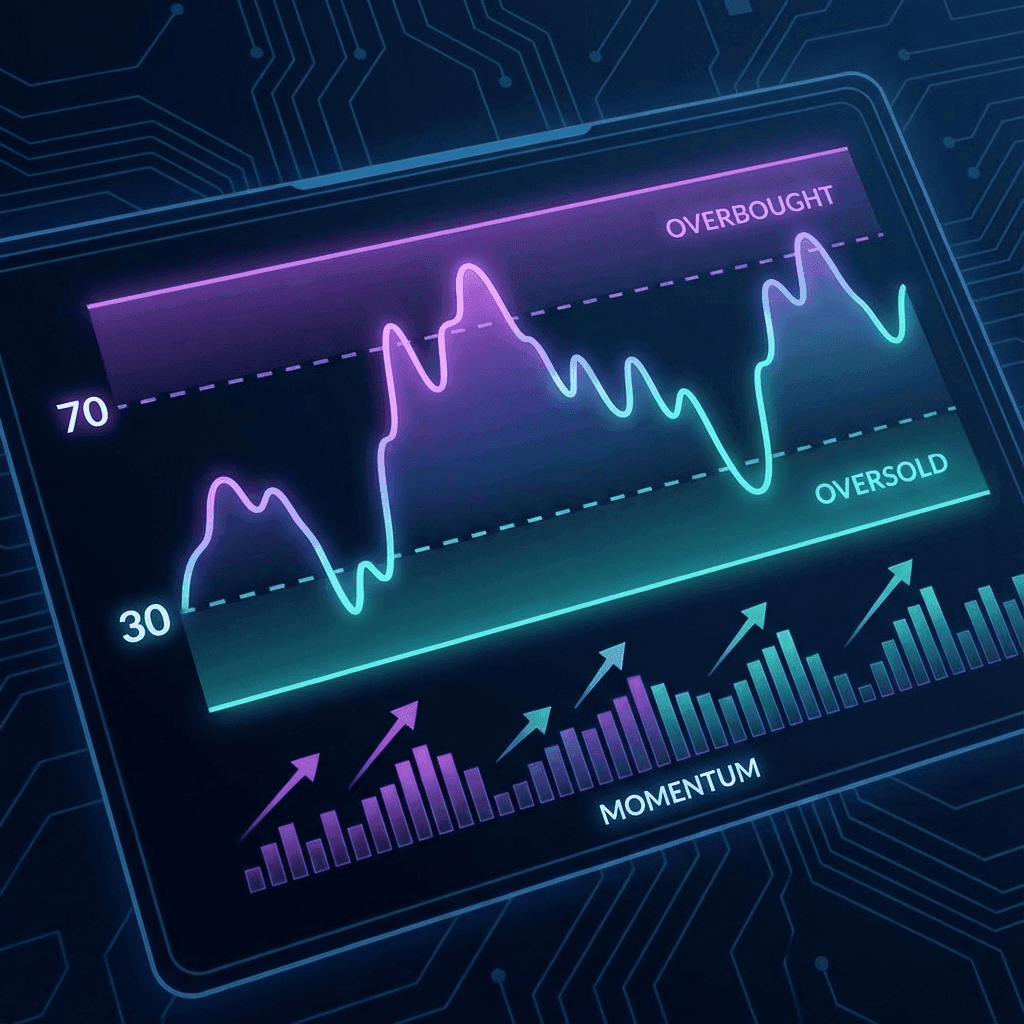




Key Takeaways
- Technical indicators are mathematical calculations that help identify trends, momentum, and potential entry/exit points.
- The most popular indicators include Moving Averages, RSI, MACD, and Bollinger Bands.
- Indicators are tools, not crystal balls — they should confirm your analysis, not replace it.
- Using 2-3 complementary indicators is optimal; too many cause analysis paralysis.
- Most indicators are freely available on platforms like TradingView and MetaTrader.
Table of Contents
Technical indicators are essential tools in every forex trader's arsenal. These mathematical calculations, displayed as visual overlays on price charts, help identify trends, measure momentum, and signal potential entry and exit points.
While no indicator can predict the future with certainty, understanding how to use them effectively can significantly improve your trading decisions. This guide covers the 10 best forex indicators and how to incorporate them into your trading strategy.
What Are Forex Indicators?
Technical indicators are mathematical formulas applied to price and volume data to generate trading signals. They help traders:
- Identify trends — Determine if the market is bullish, bearish, or ranging
- Measure momentum — Assess the strength of price movements
- Find overbought/oversold conditions — Spot potential reversals
- Time entries and exits — Generate buy/sell signals
According to Investopedia, indicators fall into two main categories: leading indicators (predict future movements) and lagging indicators (confirm past trends).
Types of Technical Indicators
📈 Trend Indicators
Identify the direction of the market:
- Moving Averages (SMA, EMA)
- MACD
- Parabolic SAR
⚡ Momentum Indicators
Measure the speed of price changes:
- RSI (Relative Strength Index)
- Stochastic Oscillator
- CCI (Commodity Channel Index)
📊 Volatility Indicators
Measure market volatility:
- Bollinger Bands
- ATR (Average True Range)
- Standard Deviation
📉 Volume Indicators
Analyze trading volume:
- Volume Profile
- VWAP
- On-Balance Volume (OBV)
10 Best Forex Trading Indicators
Moving Averages (MA)
The most widely used indicator for identifying trends. The two main types are:
- Simple Moving Average (SMA): Equal weight to all price points
- Exponential Moving Average (EMA): More weight to recent prices
Best for: Trend identification, support/resistance, crossover signals
Relative Strength Index (RSI)
A momentum oscillator that measures the speed of price changes on a 0-100 scale:
- Above 70: Overbought — potential sell signal
- Below 30: Oversold — potential buy signal
Best for: Identifying reversals, confirming trend strength
MACD (Moving Average Convergence Divergence)
Shows the relationship between two moving averages. Buy/sell signals occur when:
- MACD line crosses above signal line: Bullish signal
- MACD line crosses below signal line: Bearish signal
Best for: Trend direction, momentum, crossover signals
Bollinger Bands
A volatility indicator with three bands (middle SMA + upper/lower deviation bands):
- Price touching upper band: Potentially overbought
- Price touching lower band: Potentially oversold
- Bands squeezing: Low volatility, breakout imminent
Best for: Volatility assessment, mean reversion strategies
| # | Indicator | Type | Best For |
|---|---|---|---|
| 5 | Fibonacci Retracements | Support/Resistance | Entry levels, profit targets |
| 6 | Stochastic Oscillator | Momentum | Overbought/oversold in ranges |
| 7 | ATR (Average True Range) | Volatility | Stop-loss placement, position sizing |
| 8 | VWAP | Volume | Intraday fair value |
| 9 | Pivot Points | Support/Resistance | Key levels for day traders |
| 10 | Ichimoku Cloud | Trend | Complete trend analysis |
How to Use Indicators Effectively
✅ Best Practices
- Combine 2-3 indicators: Use a trend indicator + momentum indicator + volume indicator
- Look for confluence: Multiple indicators signaling the same direction increases probability
- Match to timeframe: Short-term traders need responsive indicators; long-term need stable ones
- Use with price action: Indicators work best when confirming what price is already showing
- Backtest your setup: Test indicator combinations on historical data before trading live
❌ Common Mistakes
- Indicator overload: Using 10+ indicators creates conflicting signals
- Ignoring context: An overbought RSI in an uptrend isn't necessarily a sell signal
- Optimizing too much: Over-fitted settings work on past data but fail on live markets
Pros and Cons of Indicators
✅ Pros
- Objective, mathematical signals
- Remove emotional decision-making
- Identify patterns invisible to the naked eye
- Free on most platforms
❌ Cons
- Lagging — react to past price data
- Can give false signals in choppy markets
- No indicator works all the time
- Over-reliance leads to missed opportunities
Best Platforms for Indicators
TradingView
Cloud-based charting with 100+ built-in indicators and thousands of community scripts.
Best for: Custom indicators, social features
MetaTrader 4/5
Industry-standard platform supported by most forex brokers.
Best for: Automated trading, vast indicator library
Frequently Asked Questions
Which indicator is best for beginners?
Moving Averages are the best starting point. They're easy to understand, visually intuitive, and work on any timeframe.
How many indicators should I use?
2-3 complementary indicators is optimal. Using more creates conflicting signals and analysis paralysis. Combine a trend indicator with a momentum indicator for best results.
Can indicators predict the market perfectly?
No. Indicators are tools based on historical data — they can't predict the future. Use them to confirm your analysis and improve probabilities, not as crystal balls.
What's the difference between leading and lagging indicators?
Leading indicators (RSI, Stochastic) try to predict future moves. Lagging indicators (Moving Averages, MACD) confirm trends after they've started. Most traders use both.
Are paid indicators better than free ones?
Not necessarily. Most professional traders use free, classic indicators available on any platform. Expensive paid indicators often over-promise and under-deliver.